
The paper grew fast for a camp barely a year old. A weekly edition sold for five dollars a year by mail, and on June 13, 1880, Clum launched a full daily edition, ten dollars a year or twenty-five cents a week for home delivery. Tombstone, still mostly canvas and rough lumber, had a daily newspaper before it had much of anything else.
The Paper Across the Street
The Epitaph was not Tombstone's first newspaper. That distinction belongs to the Nugget, which printed its own first edition on October 2, 1879, under editor Artemus E. Fay, seven months before Clum ever set up his tent. The two papers became instant rivals and stayed that way. The Democratic Nugget backed Sheriff John Behan and the Cowboy faction's sympathizers; the Republican Epitaph was firmly pro-mining and pro-Earp. By November 1880 the Nugget was calling its rival the "Daily Slop Bucket," and Clum returned fire over the years with "Cowboy Organ," "Cowboy's Obituary Organ," and "Boy-organ."
Clum did not run the paper alone. Thomas Sorin served as first editor and printer until he resigned in April 1881. Ridgley Tilden came aboard as city editor in August 1880, and Charles Reppy joined that October, eventually rising to secretary and manager. George T. Russell, the paper's foreman, had spent more than twenty years at leading San Francisco journals before coming to Arizona; he died in April 1882, during surgery for stomach cancer, leaving an invalid wife back east.
On August 1, 1881, the operation was formally incorporated as the Epitaph Printing and Publishing Company, with a board that reads like a cross-section of Tombstone's merchant establishment: Philip "Bill" Smith of the Pioneer Store, Milton B. Clapp of the Safford and Hudson Bank, Eliphalet B. Gage of the Grand Central Mine, Clum as president, and Reppy as secretary and manager. This was not a scrappy one-man operation. It was, by 1881, one of the town's real institutions, with real capital and real men of standing behind it.
That institutional weight showed in the paper's editorial choices. After the O.K. Corral gunfight, Clum suppressed the Epitaph's coverage of the full Spicer hearing testimony; the Nugget printed it in full. It was a small decision with a long echo: for generations afterward, anyone relying only on the Epitaph for that story got a noticeably thinner account than anyone who also read its rival. The Nugget would not survive much longer to enjoy the advantage. It was destroyed in the fire that swept the western part of town on May 25, 1882. The Epitaph, in one form or another, did not go the same way.
Farewell to the Old
The political ground under the Epitaph shifted fast after the O.K. Corral and the Earps' subsequent flight from the territory, and Clum and Reppy decided to sell. Samuel Purdy, formerly editor of the Yuma Free Press and described around town as "bright" and "caustic," arrived in Tombstone on April 13, 1882. Ten days later, the Nugget's own editor announced that Purdy, saloon owner and county supervisor Milton E. Joyce, and a handful of other prominent Democrats had bought the paper outright.
Clum and Reppy published their goodbye on April 29, under the headline "Farewell to the Old; Success to the New." Clum could not resist a boast on the way out, pointing to the paper's growth "from a humble tent, a hand press, and a weekly edition to a handsome two-story structure, a power press, a metropolitan daily edition, and a full-blown news and job office." He also sounded a warning: Cochise County Republicans, he wrote, had just lost "their strong right arm." The Nugget, never one to let a rival's transition pass without comment, mockingly dubbed the new ownership the "Purdyition."
New Management
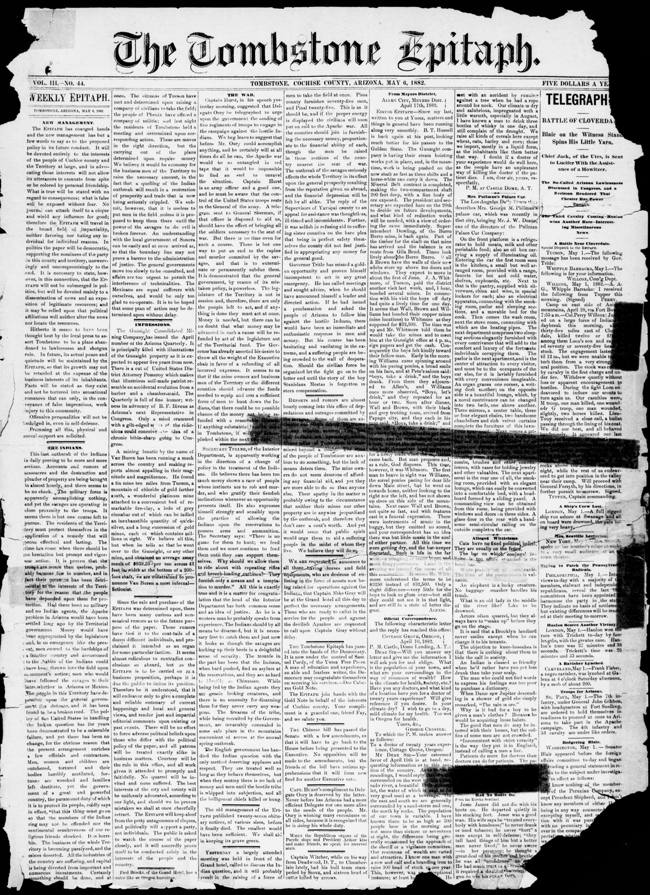
Purdy pledged impartiality without pretending the paper would drop its politics, and the office stayed put at 325 and 327 Fremont while the schedule switched to a seven-day morning run. His inaugural editorial, published May 6, 1882 and titled simply "New Management," laid out the new line directly:
It will be devoted entirely to the interests of the people of Cochise county and the Territory at large, and in advocating those interests will not allow its utterances to emanate from spite or be colored by personal friendship... In politics the paper will be democratic, supporting the nominees of the party in this county and territory, unswervingly and uncompromisingly to the end. It is necessary to state, however, in this connection, that the EPITAPH will not be submerged in politics, but will be devoted mainly to a dissemination of news.
Weekly Epitaph, "New Management," May 6, 1882Purdy's politics were nothing new; he had been on record months earlier, in a January 7, 1882 piece for the Yuma Free Press, with a measured but pointed critique of the Earp faction: Behan had killed no one, he noted, while Earp had shot three men, one of them unarmed and others with their hands raised. "No one holding an interest in a saloon should be allowed to wear a badge," he wrote. He read the People's Ticket's victory in Tombstone's early 1882 city elections as a rebuke to the Earp crowd.
That timeline mattered a few months later, when a very different version of events reached Tombstone. Doc Holliday, interviewed by the Denver Republican, claimed that "cowboys" had raided the Epitaph office on May 1, 1882 and, through what he called a "revolver argument," forced the paper to change its policy and become a "cowboy organ," driving Charles Reppy out of the country for good. The Epitaph called this a lie outright, and its own documented record backed that up: the sale was an ordinary business transaction, announced in the papers days in advance, and Purdy's Democratic, Earp-skeptical views had already been public for months before he ever owned the place. Reppy's own on-the-record response to Holliday did not pull punches, calling him "the most thoroughly equipped liar and smoothest scoundrel in the United States" and denying he had ever been friendly with the Earp faction at all.
Running the paper had its hazards regardless of politics. On July 26, 1882, a man named Oliver M. Welch struck Purdy from behind on the street; Welch was fined fifty dollars for it. Purdy did not last the year in the editor's chair. He resigned on October 6, 1882, citing his family's failing health in Tombstone and, that same day, word of a genuine tragedy: his brother-in-law, Yuma saloonkeeper Leopold Furrer, had just been shot dead by a man who had spent months trying, without success, to get money back from him.
Rule's Turn, and a Newspaper War
Richard Rule took over as editor on October 7, 1882, in a small irony the paper's own readers surely appreciated: Rule had formerly edited the Nugget, the very rival the Epitaph had already outlasted. Rule backed the Democratic ticket without apology, printing candidate Larkin W. Carr's full slate for sheriff and county office in his debut issue, and he improved the paper's telegraph service while extending its coverage to mining camps across the territory.
He also inherited a fight. Barely two weeks into his tenure, a feud broke out with the Tombstone Republican, a rival paper that would eventually be absorbed into the Epitaph itself. The dispute, covered under the headline "Nailing a Whopper," turned on a fabricated affidavit the Republican had used to back up a disputed news item; the men named as witnesses publicly denied any such affidavit was ever sworn. The Epitaph used the episode to brand its rival's reporter a fabricator outright, and along the way identified one of the Republican's employees as Charles Reppy, the same man who had left the Epitaph alongside Clum in the April sale.
Rule got his payoff at the ballot box. When the November 7, 1882 election went the Democrats' way, the Epitaph's front page on November 11 was given over almost entirely to a wall of gloating headlines: "The Democracy Triumphant Throughout the County," "You Will Never be Sheriff of Cochise," "Republican Cohorts Stricken With Overwhelming Disaster." Carr had won.
A Name Worth Suing Over
By 1884, Charles Reppy was back at the paper as publisher, and the Epitaph absorbed its old rival the Tombstone Republican outright, briefly operating under the combined name "Epitaph and Republican." The following year brought another change: David F. Cooper took over as publisher, and the paper was renamed the Tombstone Daily Record-Epitaph, by then the only paper left standing in town. Cooper made no secret of missing the competition, publicly wondering, "Won't some considerate friend start an opposition paper?" The paper's ownership in this stretch is genuinely tangled; a separate account credits attorney George Gunison Berry with acquiring the proprietorship from Reppy that same year, a claim that does not square cleanly with Cooper's own listed role. Whatever the exact chain of custody, the paper was clearly changing hands faster than anyone bothered to record consistently.
The name itself became a legal battleground later that year. James J. Nash tried to consolidate the Record-Epitaph with the Daily Tombstone, a paper he had bought from Reppy and Harry Woods, but a court injunction barred him from using the word "Epitaph" in any title at all. Nash renamed the venture simply The Tombstone, and his own paper reported the ruling with a line too good not to repeat:
An injunction granted by the court commissioner, restraining that journal from using the name of the 'Epitaph,' [the paper] will issue for the time as the 'Tombstone'... of the 'Epitaph,' which appears to be kicking even in death.
The Tombstone, March 23, 1885The fight spilled into the paper's own columns for weeks afterward: a postponed court hearing, a small unpaid wage claim used to attach the paper's property on the eve of press time, and, almost in passing, confirmation that Charles Reppy, last seen working for the rival Republican in 1882, had by 1885 become a deputy sheriff under Sheriff R. S. Hatch, even while he stood as a named defendant in the very lawsuit over what the paper was allowed to call itself.
Parsons and the Presses
While ownership churned at the top, the Epitaph's daily material often came from ordinary Tombstone residents willing to hand an editor something worth printing. George Whitwell Parsons, whose diary is the richest surviving eyewitness record of the town, was one of Clum's closest allies and a regular contributor. During the 1880 townsite controversy, Parsons fed Clum material directly for a "hot article" attacking the mayor, writing afterward that he had given Clum "the benefit of my knowledge of the matter." During Clum's own 1881 mayoral campaign, Parsons worked as a precinct organizer and contributed written material to the paper, noting with satisfaction after the count that Clum was settled in as mayor and "just the one for the place."
The relationship outlasted Clum's own ownership of the paper. In April 1886, years after Clum had sold out, Parsons had a close call during the army's Geronimo campaign, and an account of his experience was wired to the San Francisco Chronicle through the Epitaph's own telegraph connections. He was delighted by the attention, writing the next morning, "Quite an account in morning's Epitaph. Brook says my name is all over the Coast this A.M." Whatever the paper called itself in a given year, and whoever happened to own it, it remained the instrument through which Tombstone's private citizens turned their own stories into news.
Still Kicking
The Epitaph's most consequential later era began in 1928, when William Kelly, son of Arizona state historian George H. Kelly and himself a former Epitaph owner's relation, took over as editor and publisher. Kelly used the paper as the financial and promotional engine behind Tombstone's first Helldorado celebration in October 1929, borrowing five thousand dollars against the Epitaph itself and negotiating a deal with the city council that gave the paper sixty percent of the event's net proceeds. Helldorado drew six thousand visitors but left the town only a few hundred dollars ahead. Worse followed a month later: when the November 1929 county seat election went to Bisbee by a two-to-one margin, the Epitaph's assessed value collapsed from sixteen thousand dollars to four thousand. Kelly sold out to Walter Cole in April 1930 and left Tombstone for good.
The paper has had a steadier home since. According to the Tombstone Restoration Commission, it moved to its present location on Fifth Street in 1927, and in the 1960s it was purchased by Tombstone Historic Adventures, headed by Harold Love. The Love family owns and operates the Tombstone Epitaph to this day.
It is worth pausing on how unlikely that is. Clum's paper outlived the silver boom that funded it, outlived the rival that mocked it in print, outlived at least four changes of ownership and a genuine lawsuit over whether it could legally keep its own name, and outlived nearly every original building it was ever printed in. Whatever else has faded from Tombstone since 1880, the joke John Clum made when he sat down to name his newspaper has, remarkably, never stopped being true. The town got its Epitaph, and more than a century later, the Epitaph is still very much alive.
Sources
- Underhill, Lonnie J. "The 'Autobiography' of a Frontier Newspaper: The Tombstone 'Epitaph,' 1880-1885." Journal of Arizona History, vol. 56, no. 2, 2015, pp. 111-144. [Primary secondary source for the paper's founding, staff, incorporation, editorial rivalry with the Nugget, the 1882 sale to Purdy, Purdy's and Rule's tenures, and the 1884-1885 ownership and name changes.]
- Tombstone's Historic Locations (Tombstone Restoration Commission, 2008), Historic Location #24. [Source for Clum's original "Clarion" plan, the paper's 1927 move to Fifth Street, and its purchase and continued operation by the Love family.]
- Britz, Richard David. "A True to Life Reproduction: The Origins of Tombstone's Helldorado Celebration." Journal of Arizona History, vol. 42, no. 4, 2001, pp. 369-408. [Source for the William Kelly era, the financing of the 1929 Helldorado celebration, and the sale to Walter Cole.]
- Monahan, Sherry A. Tombstone's Treasure: Silver Mines and Golden Saloons. University of New Mexico Press, 2007. [Source for the Nugget's founding date and founding editor.]
- Parsons, George Whitwell. The Private Journal of George Whitwell Parsons, Volumes I and II. Edited by Carl Chafin. Cochise Classics. [Source for Parsons' direct contributions to the Epitaph during the townsite controversy, the 1881 mayoral campaign, and the 1886 Geronimo dispatch.]
- Weekly Epitaph, "New Management" (May 6, 1882, p. 1); Weekly Epitaph, "A Tough Story: Doc. Holliday Takes in a Reporter" (July 29, 1882, p. 4); Weekly Epitaph, October 7, 1882 (pp. 1-2); Weekly Epitaph, October 21, 1882 (p. 3), "Nailing a Whopper"; The Tombstone, March 23, 1885 (p. 3); The Tombstone, March 25, 1885 (pp. 2-3). [Primary sources, transcribed from the original page images in the Tombstone Silver research archive, for the direct quotations throughout this article.]