
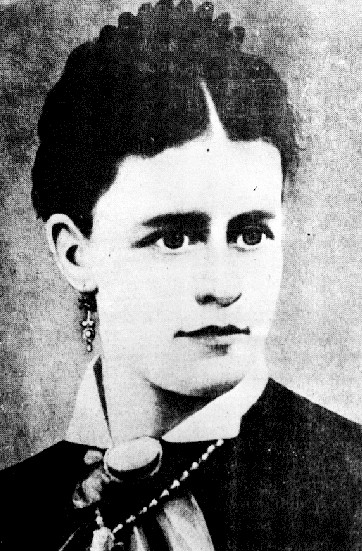
Early Life
Nellie was born in Midleton, County Cork, Ireland, around 1845, to Patrick Cashman and Frances "Fanny" Cronin. When she was about five years old the family — now widowed and impoverished by the Great Famine — emigrated to the United States, settling in Boston for the next thirteen or fourteen years. In the late 1860s the Cashmans headed west, drawn to the vibrant Irish community of San Francisco.
In 1872, Nellie and her elderly mother opened a boarding house near the silver-mining district of Pioche, Nevada. The environment was wild — thousands of Irish miners living in filth, gun fights, and labor conflict. The throbbing energy of it appealed to Nellie. She became deeply involved in the local Catholic church, then struck out alone for British Columbia.
The Cassiar Rescue, 1874–75
In the mid-1870s, Nellie operated a boarding house in the Cassiar District of northern British Columbia on the Stikine River near modern Wrangell, Alaska. She also began working gold-placer ground, picking up her first real knowledge of mining geology.
The incident that made her famous occurred in the winter of 1874–75. On a supply trip to Victoria, she heard that a severe blizzard had trapped her fellow miners in the Cassiar diggings — no one could get through. She immediately purchased medicines, food, and sleds, hired six men, sailed to Fort Wrangell, Alaska, and drove inland through heavy snows to reach the stranded miners. The Victoria Daily British Colonist reported on her rescue attempt on February 5, 1875.
Her extraordinary, freak of attempting to reach the diggings in midwinter and in the face of dangers and obstacles which appalled even the stout-hearted Fannin and thrice drove him back to Wrangell for shelter is attributed by her friends to insanity.
Victoria Daily British Colonist, February 5, 1875That rescue guaranteed her place in mining lore and was the beginning of her lifelong support for the Sisters of St. Ann — she donated to their Victoria hospital in 1875 and continued donating to their hospitals in Dawson and Fairbanks decades later.
Tombstone, Arizona, 1880–1887
In 1879, Nellie opened a restaurant in Tucson, then the territory's railroad hub. Within a year she had moved to the explosive new silver camp of Tombstone, where she became one of the fabled town's leading personalities during its glory years. During her Tombstone years she owned or managed six different enterprises, including the Russ House boarding house (which she operated with partner Joseph Pascholy after he purchased it in 1881; their first large dinner, on October 2 of that year, drew praise for its extensive menu), the Arcade Restaurant, and the Nevada Cash Store. She also held a saloon license — unusual for a woman of the era but not uncommon among Tombstone's Irish businesswomen, who ran large hotels that required a bar to be financially viable.
Historian Heidi Osselaer notes that Cashman's Russ House ran newspaper advertisements assuring potential customers it would be "conducted as a first class family hotel in every respect." The following advertisement appeared in Tombstone newspapers during 1881.
Miss Nellie
Russ House — Allen Street, Vizina Block
Meals at All Hours. Regular Dinner from 4 to 7 p.m. Open until 8 a.m.
Tombstone newspaper advertisement, 1881. Arizona Historical Society #79325.The restaurant had its own character. When a customer once loudly objected to being served beans, one of Cashman’s regulars placed his hand on his weapon and said, “You eat them beans.” The beans were quickly consumed and peace returned.
Nellie helped establish Tombstone's first hospital and its first Roman Catholic church. When freighters failed to deliver lumber for the 1882 church construction, she borrowed a mule team and wagon and hauled a load herself. In 1881, her brother-in-law Tom Cunningham died, and she took responsibility for her sister Fanny and their five children. When Fanny herself died of tuberculosis in 1884, Nellie became the sole spiritual and financial support of all five nieces and nephews.
The Baja California Expedition, 1883
When news of a gold strike in Baja California spread across the West in 1883, Nellie organized and led a 21-person prospecting expedition that included Milt Joyce (owner of the Oriental Saloon) and Mark Smith (a young lawyer who would later become a U.S. Senator). The group traveled by train to Guaymas, Mexico, then crossed the Gulf of California by boat before trekking inland to the desert around Mission Santa Gertrudis. The expedition was a bust — the finds were pitifully small, and the party nearly died from extreme heat and lack of water before turning back. What was remarkable about it was the willingness of 21 frontier veterans to place themselves under a woman's leadership.
The Bisbee Hangings, 1884
On March 28, 1884, five convicted hold-up men were hanged in Tombstone for their roles in the Bisbee Massacre. Nellie was appalled that a local entrepreneur had erected a commercial grandstand adjacent to the jail courtyard and was selling admission tickets to the event. Popular legend holds that she prevailed on her Cornish miner friends to come in at night and tear the grandstand down. The condemned were hanged on schedule, but with considerably less fanfare than had been planned.
It should be noted that much of what is commonly repeated about Nellie Cashman cannot be fully verified through primary sources. Historian Don Chaput identifies two main sources of exaggeration: her nephew Mike Cunningham (a Cochise County banker who idolized her) and ex-mayor John Clum, who wrote a widely-read account in 1931 long after the fact. Clum left Tombstone in 1882 and had little firsthand knowledge of later events. A good example: popular accounts credit Nellie with spiriting away E. B. Gage, superintendent of the Grand Central Mine, to protect him from a lynching during the 1884 miners' strike. Chaput found this almost certainly false. Gage was out of town during the incident, and the man who actually kept order was the mine's foreman, Charles Leach. These details do not diminish Nellie's genuine achievements, but they deserve scrutiny. Her story is impressive enough without embellishment.
After Tombstone: The Restless Prospector
Nellie never stopped moving. In 1888–89 she was at the gold camp at Harqua Hala in western Arizona, mining her own claims and writing a detailed article about the camp for the Arizona Daily Star (March 6, 1889) that covered geology, mining methods, assays, and ore richness — the work of a knowledgeable miner, not a bystander. She then tried her luck in Sonora, Mexico; Globe, Jerome, Prescott, and Yuma, Arizona; and several locations in Montana.
In 1897, while operating the Hotel Cashman in Yuma, she heard news of the Klondike gold strike. She closed shop, arranged financial backing, and made the difficult trek over the Chilkoot Pass to Dawson, arriving in April 1898. She worked claims, ran restaurants, contributed to St. Mary's Hospital, and pursued claim disputes in the courts with characteristic ferocity — winning some and losing others.
By 1904, as Dawson mining peaked, Nellie moved to Fairbanks, Alaska, opened a store and mining supply center, and once again raised money for the local hospital. Then she heard her last call: in 1905 she went north of the Arctic Circle to the Koyukuk River basin, prospecting along Nolan and Wiseman Creeks. She was one of the first to file claims there and would eventually file more than twenty over the next two decades. She spent most of the last twenty years of her life on Nolan Creek — the farthest north of any mining camp in the world.
In 1922, to raise funds for hydraulic equipment on her Nolan Creek claims, Nellie formed the Midnight Sun Mining Company with herself as sole trustee. She issued 50,000 shares at $2.00 each. The stock certificates stated "No Offices" and "No Officers" — she ran the company as she had run her entire career, alone. Certificate number 124, a surviving copy, suggests she did attract investors.
Death and Legacy
Late in 1924, Nellie realized her health was failing. She traveled from Nolan Creek to Fairbanks, then Juneau, then Seattle, and finally requested to be taken to St. Joseph's Hospital in Victoria, British Columbia — the very hospital she had helped fund almost forty years earlier. She died of "unresolved pneumonia" on January 4, 1925, under the care of the Sisters of St. Ann and her longtime physician, Dr. W. T. Barrett. She was about 80 years old.
Obituaries appeared across North America. The New York Times emphasized her reputation as a "champion woman musher." West Coast papers praised her use of dog sleds. Even the Engineering and Mining Journal-Press praised her wide circle of acquaintances but — in keeping with the era's blind spots — failed to credit her as a miner.
In 1994, the U.S. Postal Service honored her with a stamp in its Legends of the West series. In 1921, at age 76, Nellie told a Sunset magazine interviewer that if anything turned up somewhere else, she might "pull up stakes and start out." That sentence says everything about who she was.
Sources
- Chaput, Don. "In Search of Silver & Gold." American History, Vol. 30, Issue 6, January/February 1996. [Primary biographical source; Chaput is the author of Nellie Cashman and the North American Mining Frontier, Westernlore Press, 1995.]
- Osselaer, Heidi. "On the Wrong Side of Allen Street: The Businesswomen of Tombstone, 1878–1884." Journal of Arizona History, Vol. 55, No. 2 (Summer 2014), pp. 145–166. Arizona Historical Society.
- Tombstone Restoration Commission. Tombstone's Historic Locations (TRC Walking Tour Guide, 2008). Historic Locations #11 (Sacred Heart Church) and #34 (Russ House). Source for Russ House original founders (Sal Anderson and Jacob Smith, December 1880); Cashman and Pascholy’s October 2, 1881 dinner; lumber-hauling detail for the 1882 church construction; beans anecdote.