
It is not known how many Jews lived in Tombstone in those early days, but a Tombstone Hebrew Association was active by 1882, counted among the seven named religious congregations in the town, suggesting a sizable community. A business directory from the era shows Jews working as miners, merchants, bankers, grocers, gunsmiths, and restaurant owners. Abraham Hyman Emanuel, a Jewish mine superintendent, was the Tombstone mayor from 1896 to 1900. Josephine Sara Marcus, the long-time companion of Wyatt Earp, was also among Tombstone's Jewish residents. Jewish citizens were not buried in the city cemetery in those early days. It is not clear if that is because there was a city ordinance against permitting Jews to be buried at the cemetery though that does not seem likely given all the other types of people buried there. One local historian told me that the Jews did not want to be buried in a Gentile cemetery and preferred to be buried with their people. Whatever the reason, the Jewish cemetery was located just down the hill off the northeast corner of Boothill.
Building the Memorial
The Jewish cemetery was not maintained and fell into complete disrepair over the decades. There are no records of who, or even how many, were buried there. Around 1982, Judge C. Lawrence Huerta visited the cemetery when Tombstone author Al Turner showed the site to him and his Jewish visitors from Maryland, Israel Rubin, and his family. At that time, it was defined only by a crumbling adobe brick wall, now only about four feet high. (A retired Boothill operator named Howard Lindsey had rebuilt the wall in the late 1930s, but the site had been otherwise forgotten.) The approximately 2,500-square foot (50 feet by 50 feet) burial ground was generally unnoticed for more than 100 years. Its existence was independently confirmed in 1938 when longtime Tombstone resident Ethel Macia noted in a statewide radio address that Boothill had once contained both Chinese and Jewish sections.
Huerta, a full-blooded Yaqui Indian from Tucson who had served as a judge, community college chancellor, and member of the Arizona State Industrial Commission, was spiritually affected when Israel Rubin recited the traditional Kaddish prayer at the abandoned site. He decided to restore the now-desolate graveyard in memory of the forgotten departed who lay there. “I’m an American Indian who spent many years in Washington, D.C., working on behalf of my people,” he says. “There the Rubin family made me a part of them. The state of the Jewish cemetery at Boothill moved me deeply. A burial place is sacred to my people, and I wanted this place to be treated with the respect it once had. In honoring my Jewish brothers, I feel I am also honoring the lost and forgotten bones of my own people who lay where they fell when the west was being settled.”
In March 1983, the Tombstone City Council approved Huerta's restoration efforts, and a non-profit Arizona corporation was formed to carry out the work. David Sirota, head of the Jewish Friendship Club of Green Valley, Arizona, served as Huerta's primary partner. The group cleaned the site, built a wrought-iron fence to protect the remaining adobe wall, and cleared a marked path from the main Boothill area above. The site was rededicated in October 1983.
The Monument
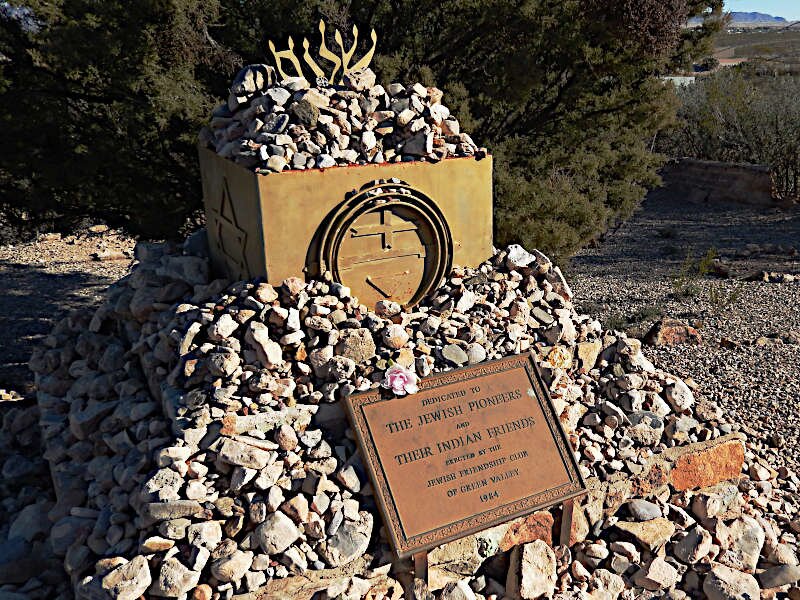
The monument stands on a platform faced with rock from nearby silver mines. It bears on its east and west sides the Star of David. On the south side is a Hohokam Indian sun symbol, the word meaning “those who vanished” in the Papago Indian language. Inside the monument, a sealed receptacle holds an Israeli bowl filled with soil from Jerusalem, so that those who lie there can “dwell in the house of the Lord forever,” along with a yarmulke, a menorah, a Kaddish cup, and prayer and hymn books. Huerta also donated a Yaqui bowl containing items he said symbolize the harmony between Jewish pioneers and the Native peoples of the region. The specially designed “menorah” flames atop the monument spell “Shalom” (Peace), symbolizing the hope that all who share Mother Earth can dwell together in harmony.
The monument was dedicated in February 1984 in a ceremony attended by approximately 250 people, with Rabbi Joseph Messing of Sierra Vista delivering the Kaddish. Representative Michael McNulty entered a tribute to the restoration effort into the Congressional Record, and the New York Times covered the dedication ceremony. Today, Temple Kol Hamidbar, the only Jewish Temple in Cochise County, holds an annual memorial service at the cemetery.
Sources
- Boothill Graveyard staff document (provided by Boothill Graveyard staff, Tombstone, Arizona). Contains: (1) Boothill’s interpretive pamphlet on the Jewish cemetery; (2) Representative Michael McNulty’s tribute, Congressional Record, vol. 130, March 28, 1984; (3) New York Times, February 28, 1984 coverage of the dedication ceremony. Primary source for Huerta’s background, David Sirota’s role, the restoration timeline, the monument’s contents, and the dedication ceremony.
- “If You Go, You Must Dress Up” (Underhill 2016), Journal of Arizona History, vol. 57, no. 3. Source for the Hebrew Association as one of seven named religious congregations in Tombstone by July 1882.
- “Boot Hill Burlesque” (Britz 2003), Journal of Arizona History, vol. 44, no. 3. Source for Ethel Macia’s 1938 radio address confirming a Jewish section at Boothill.
Location
The Jewish Memorial is accessed through Boothill Graveyard at 408 AZ 80 Highway.