
History
Note: This article concerns the history of the Courthouse. Another article discusses the Haunted Courthouse.
The Arizona Territorial government selected Tombstone to be the county seat for the newly created Cochise County in 1881. A new courthouse was built out of wood. However, the 1881 fire destroyed that building, so the supervisors temporarily located the courthouse on the ground floor of the Mining Exchange Building on Fremont Street while a new courthouse was being built. That building also served as the venue for the preliminary hearing following the O.K. Corral gunfight — the so-called Spicer Hearing of November 1881 — since the permanent courthouse had not yet been completed. Today that location is a parking lot across from Schieffelin Hall.
The supervisors then had a brick kiln built on the corner of Third and Toughnut and brought in Chinese brick makers and bricklayers to build the courthouse that is still standing on that corner. The cornerstone was laid on July 6, 1882; beneath it workers deposited a small collection of objects — coins, cigars, specimens of ore, and handwritten poems and essays. The entire building was finished in 1883 at a cost of about $50,000. Designed in the Italian villa style, it is a two-story red brick building in the shape of a Latin cross, with white stone quoins and a one-story cupola with a mansard roof and decorative gingerbread cresting. A projecting central pavilion with a front porch supported by Tuscan columns faces Toughnut Street. Inside, Sheriff John Behan's office occupied the ground floor, first door to the right; an iron spiral stair led to the second-floor courtroom. Within months of opening the building had become the civic hub of town: George Parsons attended a Broom Brigade drill at the new courthouse in January 1883, and a citizens' meeting in February that voted to issue $100,000 in county bonds.
The most dramatic chapter in the courthouse's history came in February 1884, when Judge Daniel H. Pinney convened a special session to try the six men responsible for the Bisbee Massacre of December 1883. Five masked gunmen had robbed a Bisbee general store at gunpoint, killing four civilians including a pregnant woman. All six gang members, including their ringleader John Heith, were captured within 45 days. The five direct participants were convicted of first-degree murder and sentenced to hang. Heith was tried separately and received only a second-degree murder verdict — life imprisonment — that outraged the public. On Washington's Birthday, February 22, 1884, miners from the Grand Central, Contention, and Tough Nut mines marched to the Tombstone jail and hanged Heith from a telegraph pole on Toughnut Street. George Parsons, who had helped canvass the town for reward money after the massacre, captured the day with characteristic economy: "Hanging in A.M. and dance in P.M. Good combination." Sheriff Jerome Ward then executed the five convicted men on March 28, 1884, before 500 invited witnesses.
Cochise County offices were moved from Tombstone to Bisbee in 1929, so this building was left vacant. In 1948 a company began to turn the building into a hotel, but they ran out of money and stopped that project after gutting it. In 1952 the Tombstone Restoration Commission began restoring the building, and in 1960 the Arizona State Parks Board accepted the building and turned it into the first operational state park in Arizona. The courthouse was designated a National Historical Landmark on October 1, 1962, and added to the National Register of Historic Places on April 13, 1972. Today, the courthouse is the smallest state park in Arizona and contains a professionally curated museum of artifacts from the early days of Tombstone. As an interesting aside, the Schieffelin Monument, about three miles northwest of the city, is also part of this state park.
Photos
The courthouse is a professionally-curated museum and the displays are frequently changed. The photos below were taken in the courthouse; but if you visit, you will likely find different displays.
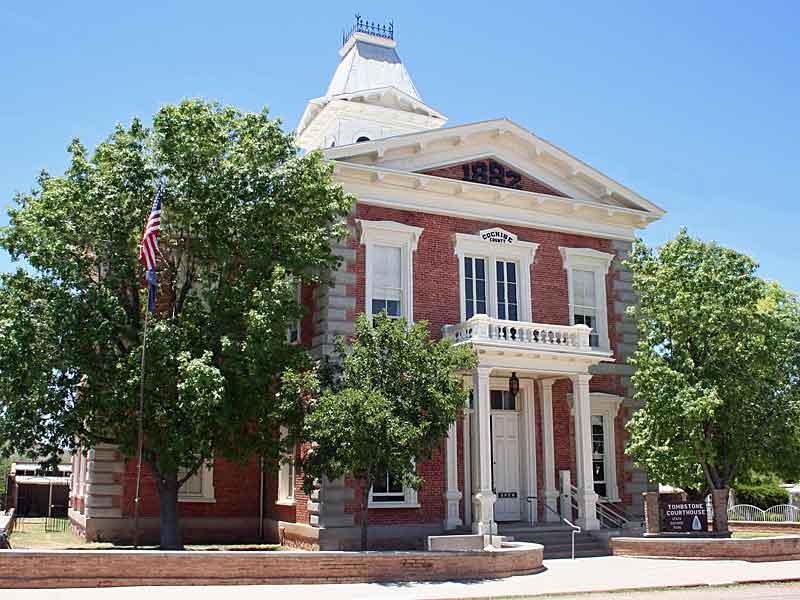
Old Cochise County Courthouse
This is the old Cochise County Courthouse as seen from Toughnut Street.
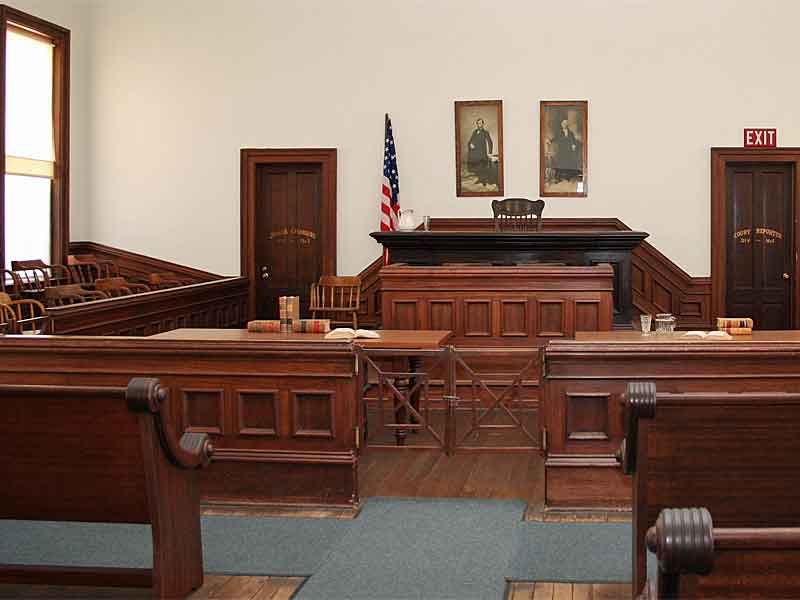
Courtroom in the Courthouse
This is the restored courtroom in the old courthouse.
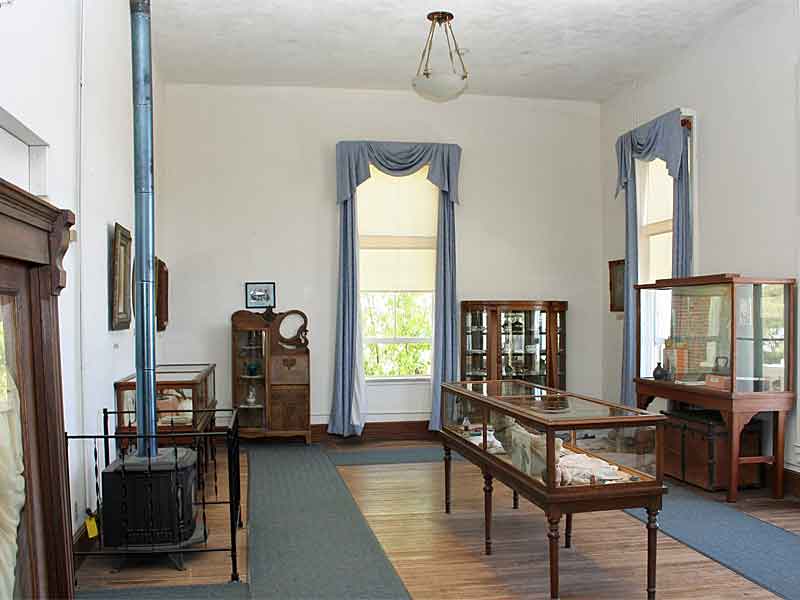
Display Cases in the Courthouse
The courthouse contains a wonderful museum and these are just a few of the display cases found there.
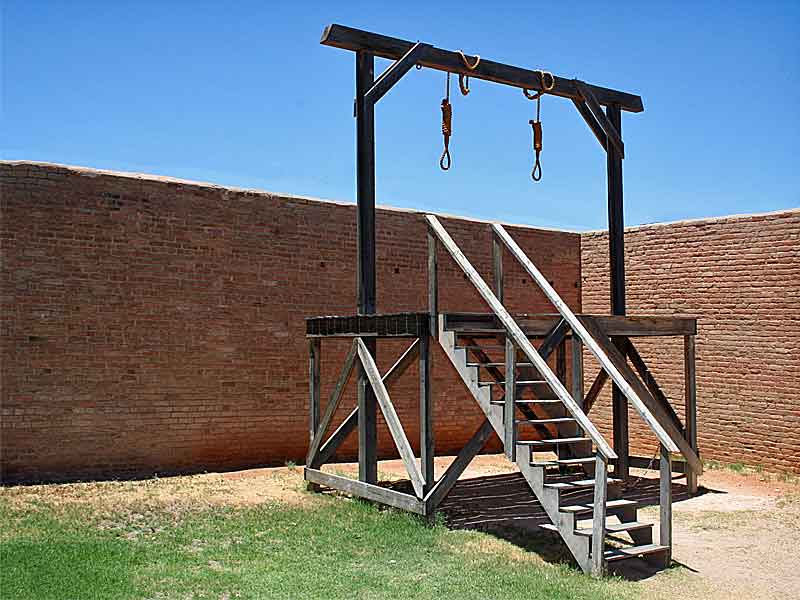
Gallows Behind the Courthouse
The courthouse museum includes an example of gallows in the yard.
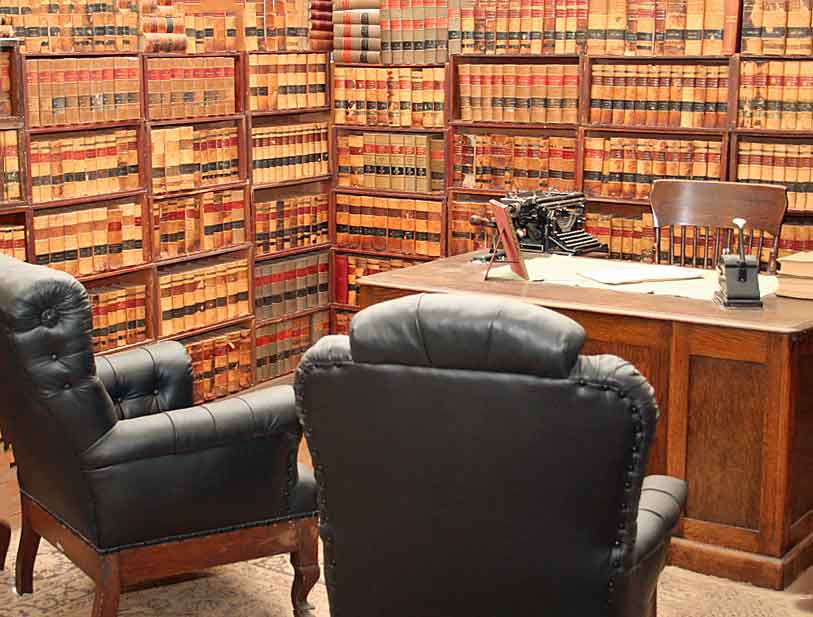
Lawyer's Office in the Courthouse
The courthouse museum includes an office that has been set up to resemble a lawyer's office in those early days.
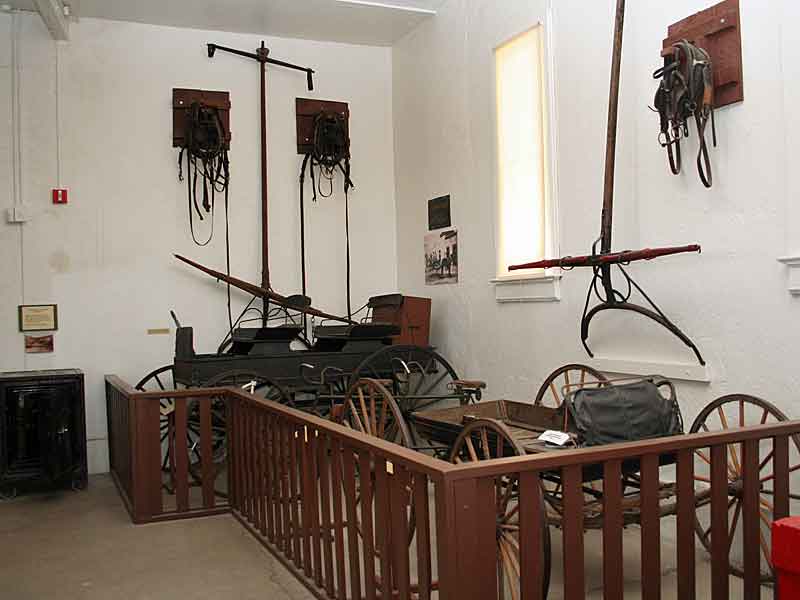
Wagons on Display
One of the large rooms on the ground floor contains a couple of wagons and some typical ranching equipment.
Location
The old Cochise County courthouse is located at 223 E Toughnut St.
Sources
- NPS National Register of Historic Places nomination form (Form 10-300). Primary source for construction date, cost, dimensions, architectural description, NHL designation (October 1, 1962), and "oldest courthouse still standing in Arizona" characterization.
- NPS Tombstone Historic District inventory. Source for Italian villa style, Latin cross plan, Tuscan column description, TRC purchase, and State Park Museum opening date (July 1, 1960).
- Tombstone's Historic Locations, Tombstone Restoration Commission walking tour guide (2008). Source for cornerstone offerings (coins, cigars, ore, poems and essays), the 1948 aborted hotel conversion, and the 1952–1960 TRC restoration timeline.
- Lynn R. Ellis, "Sheriff Jerome L. Ward and the Bisbee Massacre of 1883," Journal of Arizona History, vol. 35, no. 3 (1994), pp. 315–342. Primary source for Bisbee Massacre background, trial proceedings, Heith lynching, and the five official hangings.
- George W. Parsons, Journal, Volume 2 (June 28, 1882 – March 31, 1887), Arizona Historical Society. Source for the Broom Brigade drill at the new courthouse (January 1883), the county bond vote (February 1883), and the Bisbee Massacre lynching day ("Hanging in A.M. and dance in P.M.").